Sunday, 19 June 2016

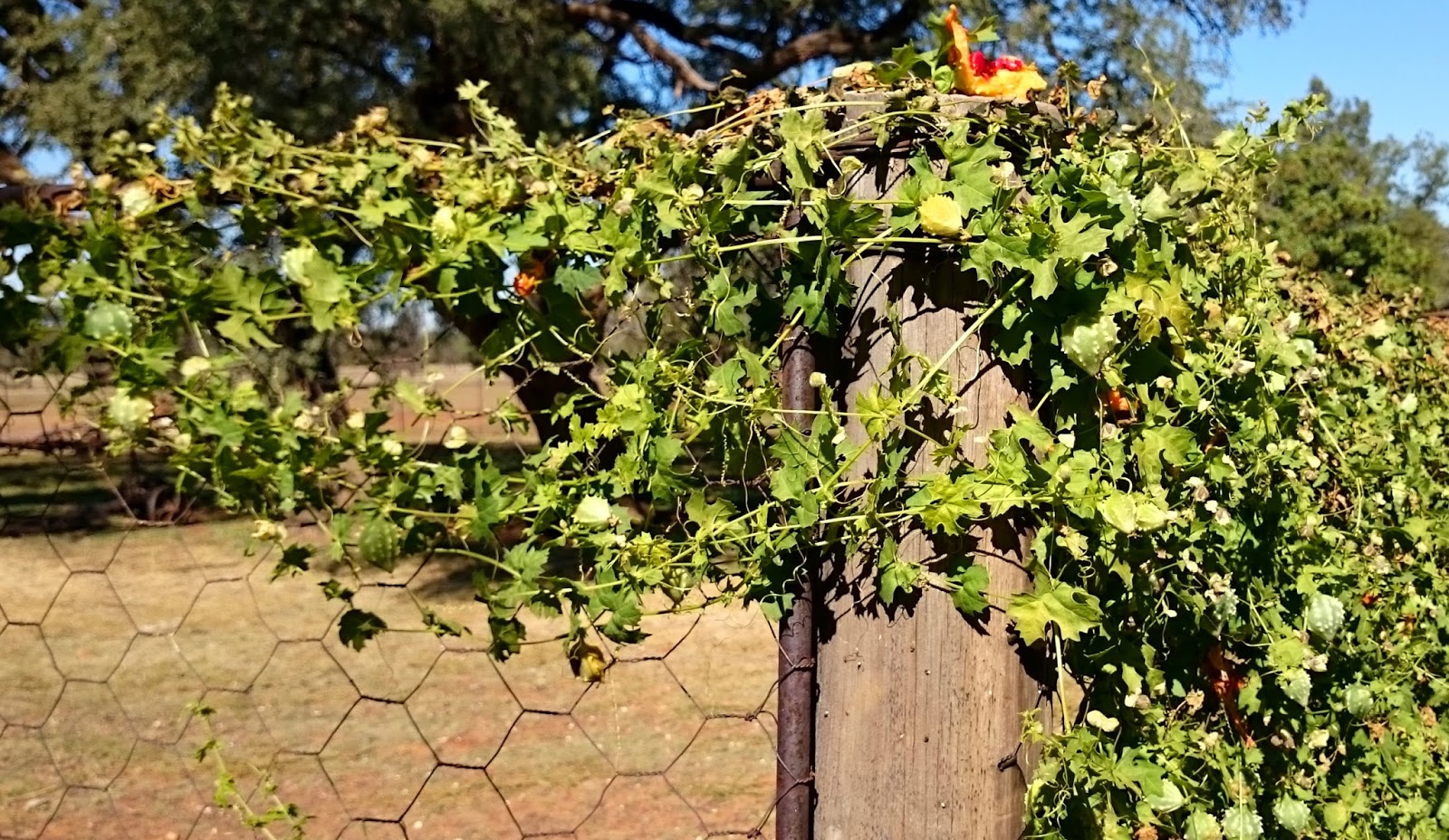
Momordica Cardiospermoides Klotzsch

For many years I've seen these strange shaped orange pods growing from pretty vines all over the farm. Today I finally decided to learn a bit more about these interesting plants. The best description I could find is from www.plantzafrica.com, I only copied some of the info. If you would like to read more, please visit their website.

Momordica Cardiospermoides

Momordica Cardiospermoides Klotzsch

Family: Cucurbitaceae (pumpkin family)
Common names: bitter gourd (Eng.); inshubaba (siSwati); ntwe (seTswana)

This climber has a foetid smell, but makes up for it with showy orange-yellow flowers and large, fleshy, bulging orange-red ripe fruits that will attract birds to your garden.

Description 
Herbaceous climber with a perennial tuberous rootstock, all parts foetid. Rootstock consisting of several tough spindle-shaped, thickened roots covered with a yellow bark. Stems annual, several, much-branched, hairless, angular, up to 10 m long. Leaves short-stalked, compound, up to 120 mm long, deeply cut to the main vein, with about 10-20 leaflets; membranous, hairless, dark green above, paler below. Tendrils very thin, simple or split in two. Flowers either male or female, but on the same plant (monoecious), all stalked and solitary. Male flowers supported by a prominent sessile bract which is 10-20 mm wide, almost semi-circular, hairless, light green, with a few distinct longitudinal veins; corolla yellow to orange with greenish, raised veins outside, a dirty green near the base inside, 15-25 mm long. Female flowers with bract rather small or absent, corolla very similar to, but somewhat smaller than in male flowers. Fruit fleshy with a pink, gelatinous mucilage, more or less egg-shaped to sausage-shaped, smooth, hairless, dark green with lighter blotches when unripe, orange-red to scarlet when ripe, warty or bulging irregularly, indehiscent, 50-100 x 25-50 mm. Seeds many, rose-red turning crimson or dark brown when ripe, each covered with whitish soft flesh, more or less ovate-elliptic in outline, much compressed with a few irregular rows of flat warts or irregularly twisting ridges, about 12 mm long, about 8 mm wide and about 4 mm thick.

Distribution 
M. cardiospermoides occurs from Tanzania, Malawi, Zambia, Zimbabwe, Mozambique and Botswana down to Swaziland and South Africa where it is found in the Limpopo, North-West (where I found mine), Gauteng and Mpumalanga provinces and in the Ingwavuma district in northern KwaZulu-Natal.

This species grows in well-drained sandy and sandy loam soil, among rocks on granite/gneiss outcrops, also on flat areas, along river banks and roadsides. It will grow in full sun, but prefers semi-shade among trees and shrubs. It is found in various types of woodland, savanna and wooded grassland vegetation and climbs onto all kinds of trees and shrubs, also on hedges and wire fences.

Derivation of the name 
The genus name Momordica could perhaps refer to the sculptured seeds or the uneven appearance of the fruits, which look as if they had been bitten; the Latin mordeo means to bite. However, Jackson (1990) doubts this explanation. Momordica is an Old World genus of about 40 species, the majority of them in tropical Africa. They are recognized by the seeds that are almost always enveloped in reddish pulp and by the often prominent bracts subtending the male flowers.
The species name cardiospermoides refers to the resemblance of the compound leaves with those of Cardiospermum (Sapindaceae), the heart-seed or balloon-vine, also a climber. M. cardiospermoides was formerly known as M. clematidea Sond.; once again the species name refers to the compound leaves which also resemble those of Clematis (Ranunculaceae), another climber known as the traveller's joy. M. cardiospermoides is unique in the Cucurbitaceae in southern Africa in having compound leaves.

  • Birds will certainly eat the brightly coloured and fleshy ripe fruit.
  • Meeuse (1959) stated that 'the first flowers, male ones, as is the rule among the monoecious Cucurbitaceae, appear in late spring or early summer.
  • Female flowers appear on the same plant usually one or two months later'. 
  • Most observers agree that M. cardiospermoides has a disagreeable smell, but a few collectors described the plant as fragrant!

Author: Mienkie Welman
National Herbarium, Pretoria
May 2005
www.plantzafrica.com

More photos:

Momordica Cardiospermoides

Momordica Cardiospermoides

Momordica Cardiospermoides

Momordica Cardiospermoides


Wednesday, 5 November 2014

Keep dogs out of your potted plants

My four-legged friends have been driving me up the wall - ripping every single plant that ever dared survive from my garden and placing it nicely in the doorway for me to see when I return from work.

I decided to invest in some pots, as the furries wouldn't possibly destroy potted plants. How very wrong I was... They seemed to take this on with a "challenge accepted" attitude.

One day I lost my cool and burst into angry tears. My boyfriend came up with an amazing plan to save the plants' (and the dogs') lives.

He bought 3 wired hanging baskets from the nursery, similar to the one in this image. We removed the insides and the chains, tipped the baskets upside down and placed them over each pot. He measured the pots before heading to the nursery to know which sized baskets would work best. (I suppose you could make your own frames if you are the handy DIY type.)

Voila! It works like a bomb.  Give it a try before you reach the point of explosion.

Keeping dogs out of your flower pots / Hou honde uit jou blompotte
I finally have some colour in my garden! Couldn't be happier :)


______________________________ Afrikaans ______________________________

Hou honde uit jou potplante


My vier-been vriende was besig om my teen die mure te dryf - elke plantjie wat gedink het hy staan 'n kans om te groei was dadelik uitgeruk en mooi voor die voordeur neergelê vir my om te sien wanneer ek by die huis kom.

Ek het besluit om 'n paar potte te koop, hulle sal sekerlik nie potplante ook uitgrawe nie. Ek was baie verkeerd... Hulle het dit met 'n "challenge accepted" houding aanvaar.

Een dag het ek dit verloor en in "angry tears" uitgebars. Dit was toé dat my kerel met 'n briljante plan vorendag gekom het om die lewens van die plante (sowel as die honde) te red.

Hy het 3 draad mandjies by die kwekery gekoop, soortgelyk aan hierdie foto. Ons het die binnekant en kettings verwyder, die mandjies onderste-bo gedraai en oor elke pot geplaas. Hy het die potte gemeet voordat hy die mandjies by die kwekery gekoop het. (Ek is seker jy sal self hierdie mandjies kan maak as jy die handige DIY-tipe is.)

Voila! Dit werk soos 'n bom. Probeer dit voordat jy die punt van ontplof bereik.


Tuesday, 1 July 2014

Wonderful Winter 2014

I love me some winter!

All the autumn leaves have fallen to the ground, leaving the trees bare for all of us to see their beautiful silhouettes. Weekends are spent indoors catching up on series and movies with hot chocolate in the biggest mug in the house. PJ's and slippers, blankets and cuddles...

Cheers to all of that ♥


Maybe this winter is exactly wat I need...

Friday, 3 May 2013

The Red Panda


Today I heard something that I never knew before. The Mozilla Firefox logo isn't a fox at all, it's a Red Panda. "Firefox" is just another name for the red panda. I always thought it was just a regular old fox wrapped around a ball (the earth I'm presuming). The firefox isn't even related to the fox.

So I looked up the red panda, and it's the cutest little thing. Here's what I could find out about them:

The red panda (Ailurus fulgens, lit. "shining cat") ("Rooi Panda" in Afrikaans)

Fast Facts
from - http://animals.nationalgeographic.com/animals/mammals/red-panda/
Type: Mammal
Diet: Herbivore
Average life span in the wild: 8 years
Size: Head and body, 20 to 26 in (50 to 65 cm); Tail, 12 to 20 in (30 to 50 cm)
Weight: 12 to 20 lbs (5.4 to 9 kg)
Protection status:Endangered

Is it a panda or a fox? Neither.

They are endangered animals. Mainly because they are victims of deforestation. Their natural space is shrinking as more and more forests are destroyed by logging and the spread of agriculture. They are hunted because of their fox like tail which in China is considered as a good luck charm for newlywed couples.

The red panda is protected in all range countries, and hunting is illegal.

They can be found in Asia, China and the Himalayas.

"They are slightly larger than a domestic cat, have reddish-brown fur, a long, shaggy tail, and a waddling gait due to its shorter front legs. It feeds mainly on bamboo, but is omnivorous and may also eat eggs, birds, insects, and small mammals. It is a solitary animal, mainly active from dusk to dawn, and is largely sedentary during the day." - http://en.wikipedia.org/wiki/Red_panda

The pandas use their ringed tails as wraparound blankets in the chilly mountain heights.

These animals spend most of their lives in trees and even sleep aloft. When foraging, they are most active at night as well as in the gloaming hours of dusk and dawn.

They are shy and solitary except when mating. Females give birth in the spring and summer, typically to one to four young. Young red pandas remain in their nests for about 90 days, during which time their mother cares for them. (Males take little or no interest in their offspring.) - 

The red panda has a naturally low birth rate (usually single or twin births per year), and a high death rate in the wild.

And if you want to know how to pick up a baby red panda in 5 easy steps, click here. (Warning - cute overload!)

Since I will not be walking into any red panda's around here in South Africa, I won't be able to take any snaps of these little guys (unless I find myself in the Himalayas before posting this). So I have stolen some photos that I liked from the web:


Thursday, 2 May 2013

Mossel Bay Seagulls

Long time no blogging. Still have nothing to say, just wanted to share this photo of some seagulls at the Mossel Bay harbour. I think it turned out pretty nice :)

Seagulls at the Mossel Bay harbour

Friday, 1 March 2013

Goue Wawielwebspinnekop


The Goue Wawielwebspinnekop is known in English as the South African banded-legged golden orb-web spider.

"Its size and formidable looks make this one of the most recognisable and easy to identify spider species. Although it is frightening to look at, this spider is non-aggressive and relatively harmless. It can deliver a painful bite if severely provoked, but the venom is not lethal, generally only causing redness and blistering."
- http://www.sabisabi.com/wildfacts/golden-orb-web-spider 

"The spider species Nephila senegalensis is commonly known as the banded-legged golden orb-web spider. The name comes from the fact that the joints of the spider are typically coloured a golden yellow. It is common in the savannas of South Africa. Males are much smaller than females. These spiders are diurnal and weave impressive webs."
- http://en.wikipedia.org/wiki/Nephila_senegalensis

The table below comes from this PDF document - http://www.spiderclub.co.za/Docs/SCSA_Nephilidae_SA.pdf

ATTRIBUTES Nephila senegalensis annulata.
Banded legged Nephila
Known distribution in South Africa. Throughout all provinces.
Colour of silk, shape and placement of web, retreat and garbage line. Strong yellow silk. Very large orb web in open or amongst trees, etc. with protective trip lines and a garbage line. No retreat.
Average body length of adult female. 25 - 30 mm.
Legs. Colour and presence or absence of brushes. Banded yellow and dark brown. Brushes of hair on legs 1, 2 & 4.
Carapace. Brown or silvery.
Sternum Yellow
Abdomen Cylindrical. Variable but usually with a distinct yellow and black pattern dorsally and yellow with black patterns ventrally. Colours and patterns of subadults and juveniles different.
Palps Yellow

"Typically of Nephila, the legs have a brush on the tibia of the first, second and fourth pairs of legs. The blackish legs are banded with yellow. The Banded-legged Nephila has a body length of 25-30mm. The abdomen is black with yellow bands or spots while ventrally it has a yellow sternum."
- http://www.biodiversityexplorer.org/arachnids/spiders/nephilidae/nephila_senegalensis.htm


See also:


Wednesday, 27 February 2013

Wouldn't you like this in your backyard?

One of the things I really dislike about living in the city is that I have no view of anything worth looking at beyond my litle garden. I can see my neighbours' houses and a shopping centre or two, streets and cars, an oversized church and a little patch of land that hasn't been turned into profit making machine.

So I look at this photo and I wonder, who wouldn't like to see this at the end of every day when the sun sets?

South Africa... You are truly beautiful! Even if we can't always see your beauty in the city.

I wish everyone had their own personal sunset :)

Wouldn't you like this in your backyard?


Monday, 25 February 2013

Elephants & Cattle

Everyday I see so many beautiful photos of perfectly bred animals throughout South Africa. And although I don't know much about the actual breeding that goes on to get these animals where they are, I know an interesting picture when I see one.

Who would have known that there are people out there using elephants to herd cattle? I didn't! And I don't know the reason behind this either, they can't be easier to handle than horses... I'll see if I can find out what's going on here. Tried to find out, no reply... Bummer!

Small things that make me happy :-)


Source: www.zz2livestock.co.za


Wednesday, 23 January 2013

Colours of the veld

This photo was taken just over a year ago when I was doing one of my random drives on the game farm. I love the colours. The veld, the trees, the sky (even though it isn't its usual shade of blue), the animals and even the "ant castles" as we used to cal them when we were little. They all go perfectly together.

I zoomed in quite a bit. They don't allow me anywhere near them. Snobs.

In this photo there are a few Oryx gazella (gemsbok), Damaliscus pygargus phillipsi (blesbok) and two members of the horse family (zebra). I used their scientific names just in case someone didn't know what I was talking about...

Have a super Wednesday (what's left of it) :)

Au revoir!

In this photo there are a few Oryx gazella (gemsbok), Damaliscus pygargus phillipsi (blesbok) and two members of the horse family (zebra). I used their scientific names just in case someone didn't know what I was talking about...
Buck buck buck buck buck...


Monday, 21 January 2013

Eurotrip, any tips?


If anyone reading this has some useful tips on planning a European trip, please help me out.

I've started planning a trip for two. It will most likely happen in 2014. And we will be going for about 15-16 days.

  • How many days should one spend per country?
  • Which cities / towns / hidden places are the best to see (I can't make my mind up, there are sooo many that I love, and so many that I don't even know of yet)
  • Is it a good idea to travel by train?
  • Which country has the best castles?
  • Which country will be best to start with, if I want to end in England?
  • Is Egyptair any good? They seem cheapest.
  • Any kind of info will be much appreciated, so if you have done this before, share the secrets. Especially if you are South African :)

I know that there are great traveling agencies out there. I just think with very careful planning I can organise my own trip at a much better price.


Cheerio :)

While doing some research, I found a little European country that I have never heard of before - Liechtenstein. It looks so beautiful.
So this castle is in Germany, not Liechtenstein... It's name is the Lichtenstein Castle... Apologies :) 


The Vaduz Castle, Liechtenstein

Thursday, 17 January 2013

Lessons by Lucy

Just came across this on www.swiss-miss.com and thought it was too cute not to share. Originally posted here. A beautiful story behind these 10 life lessons by Liz Danzico. Worth a read.

  1. Learn at least one impressive trick.
  2. Shake when wet.
  3. Wag.
  4. When off the leash, it is best to run to a loved one.
  5. Accept treats from strangers energetically yet cautiously.
  6. Roll in grass whenever possible.
  7. Wonderful things can sometimes be found in the trash.
  8. Barking is a last resort.
  9. Know when the right time is to let go of what you love.
  10. True life partners do exist.

"How lucky we are if we have known dog hair."

Wednesday, 16 January 2013

Brock & Jasmine


I often look at photos that remind me of good times. As I was doing this today I came accross these photos. These two Boerboel sisters are Jasmine and Brock. The story is so lovely and sad at the same time. They came to the farm around nine or ten years ago, and ever since then they were side by side, never seperated. The happiest, friendliest, most loving dogs in the world.

In short, Jasmine passed away from cancer in 2011. Just a couple of days later Brock became really skinny and passed away too. I'm sure she died of a broken heart. She couldn't live without her lifelong best friend, her sister. Which is what makes this so sad for me. Dogs have much more feelings than we realise.

I miss these eyes so much.

RIP Brock & Jasmine x

Jasmine and Brock
Jasmine and Brock
The Boerboel, Brock
The Boerboel, Brock

The Boerboel, Jasmine

Monday, 14 January 2013

Sunset + silhouette


The clouds looked amazing while the sun was setting on this day. Gold, pink, purple...

This birdie was just chilling. I expected him to fly away as I got closer, but I think he was enjoying the attention, and maybe he was enjoying the sunset too :)


Sunday, 13 January 2013

Curious Collie

Hello there from a very hot South African afternoon

This is such a special photo, showing the inquisitive side of a puppy so perfectly. This is my mother's pup. She's all grown up now, but still as curious as ever. Love the way she's looking at that beetle :)

Sadly, the beetle didn't make the other side of this photo... Curiosity lead to playtime, playtime lead to death...

Brown Border Collie and Beetle
Inspecting the unknown

Wednesday, 9 January 2013

The moon in the morning sky


The moon in the morning sky...

This was early one morning, two or three days after the full moon. Hardly anything was awake besides myself, a couple of birdies and the moon :)

The moon in the morning sky...
Birds sitting, moon still shining bright.

Tuesday, 8 January 2013

Botter Spinnekop

The 'Botter Spinnekop' (Argiope Australis)


The Botter Spinnekop, as it is known in some parts of South Africa, is also known as the Argiope Australis.

From what I gather their venom is not known to be harmful to man, and the only way they can really bite you is by trying to take them from their web. They are pretty beneficial for keeping down insect numbers.

Here is some more information from other websites:

"The larger female has a yellow and black scalloped abdomen. The legs are thin and black striped. They support the spider to normally hang upside down with its two back and two front legs together. From a distance the spider appears to have four instead of eight legs. The head is silvery grey. The males are far smaller and quite insignificant in comparison.
These spiders are harmless to man." 

"A common spider found in many gardens and in the fynbos where it builds its characteristic orb web with a zig-zag white silk cross pattern in the centre."

"The female Argiope spends her time hanging head down in the centre of her web, her two pairs of forelegs held together and stretched out forwards mirrored by the hind two pairs stretching out backwards, forming an X."

"The Black and Yellow Garden Spider (Argiope australis) is a common spider found in in the fynbos and is a member of the orb-web group of spiders. The larger female has a yellow and black scalloped abdomen. These spiders are harmless to man. They construct large wheel-like webs (orbs). As a diurnal species they continually repair their webs, using them for a number of days. The webs, mainly stretched across bushes, are normally built within one metre of the ground. The webs occupy the aerial passage amongst vegetation in the path of flying insects. The spider sits on the web waiting for prey to get trapped."

Monday, 7 January 2013

Duisendpoot

I was watching this little fella climb up a tree the other day. He didn't do a great job, but I liked the way his legs moved :)

Duisendpoot
Duisendpoot

Reflections

I love this place. The two thorn trees that reflect in the farm dam make such a beautiful scene, no matter what time of the day I snap this it always makes a beautiful photo. But my favourite time to hang around here is at sunset :)

It's really just a plain old round farm dam, I cropped the sides to make it look bigger.

The two "kameeldoringbome" reflecting in the farm dam at sunset.

Thursday, 3 January 2013

My first blog

Hello world from a first time blogger,

This year, I hope to find out what this blogging craze is all about. So I'm starting my own one on this third day of 2013 - welcome to it :)

I grew up on a farm in South Africa, and fortunately my parents are still around so I am able to visit them. It is a place so dear to my heart and when I'm there I love taking photos of the things I see. I'm no photographer, but I would like to share some of the photos I have taken over the years because I believe it is too beautiful to keep to myself!

- I'm much better with photos than words, so please excuse me if some of the things I say make no sense! -


I love my dogs... So they might feature here quite often :)

Cheerio x

This is Domino, my Shar Pei / Boerboel crossbreed dog. A run in the game camp chasing after buck takes it's toll on the poor girl. Time to cool off!